

A residential proxy account is two things at once: a balance of spendable credit and a route through other people's home connections. Both properties make it worth stealing, and neither is obvious from a dashboard that looks like any other software subscription.
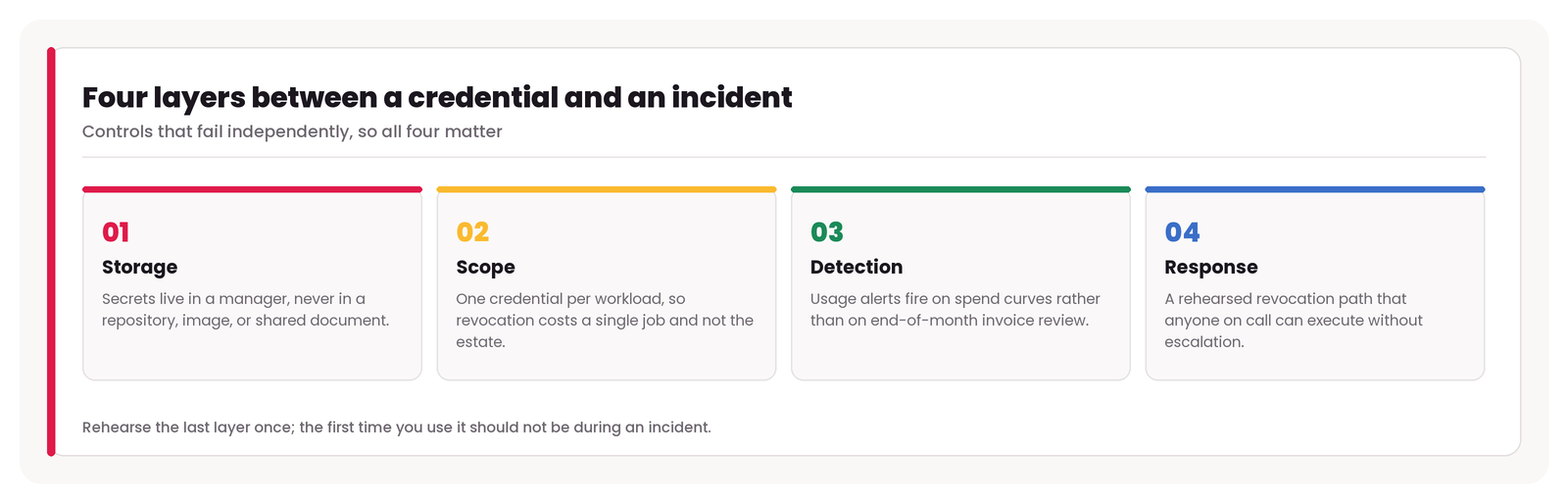
Securing that account is ordinary production discipline applied to a service teams often treat as peripheral. This article covers the controls that matter, in the order an attacker would test them: where the credential lives, who can create more, how misuse is detected, and how quickly access can be taken away.
Treat the account as production infrastructure
Proxy access usually enters an organisation through an engineer with a card and a deadline, which is why it so often sits outside change control, outside the asset register and outside the on-call runbook. The fastest improvement available is administrative: put the account on the same inventory as every other production dependency, with a named owner, a documented purpose and a renewal date.
That single act pulls the remaining controls along with it. Assets on the register get access reviews, get included in incident response, and get noticed when the person who set them up leaves. Assets that are not on it get none of those things regardless of how carefully the original engineer configured them.
Restrict who can mint access
Most residential dashboards allow any authenticated user to generate new credentials, create sub-users and raise usage caps. Left at defaults, that means every person with the login can quietly expand the attack surface, and nothing in the interface flags it.
- Reduce the number of accounts that can create credentials to the smallest workable set
- Enable multi-factor authentication on the console itself, not only on your identity provider
- Use sub-accounts for teams and contractors so access can be closed independently
- Set per-credential usage ceilings so an unnoticed leak has a bounded cost
- Turn on audit logging where it exists, and confirm it records credential creation
Where a provider offers only a single master login with no roles, that limitation belongs in the security review before purchase rather than in a post-incident write-up.
Detect misuse through spend, not through review
The first visible sign of a compromised proxy account is almost never a security alert. It is a consumption curve that does not match the schedule: traffic at hours nothing is scheduled, a region nobody targets, or a step change on a quiet day. Monthly invoice review finds that pattern weeks late.
Alerting on the curve rather than the total is the practical control. Set a threshold on hourly consumption relative to the normal pattern, route it to a channel a human reads, and treat an unexplained spike as an incident until proven otherwise. It is a cheap control that catches both compromise and the more common cause, a runaway loop in your own code.
| Signal | Likely cause | First response |
|---|---|---|
| Traffic outside scheduled hours | Credential in use elsewhere | Revoke and reissue |
| Unfamiliar target regions | Leaked string being resold | Revoke, then review audit log |
| Sudden concurrency increase | Runaway retry loop | Pause the job, inspect the queue |
| Authentication failures rising | Allowlist drift after deployment | Compare declared egress ranges |
| Balance falling with no output | Collector failing after transfer | Check failure classification |
Make revocation something anyone can do
The last layer is the one teams rehearse least. Revocation should be a documented sequence a person on call can execute without escalation: where the credential is stored, which job consumes it, how to issue a replacement, and how to confirm the old one is dead. If any step requires the engineer who built the pipeline, the control does not exist at three in the morning.
Rehearse it once against a low-priority workload. The exercise reliably surfaces a hard-coded string somewhere, a deployment that caches the old value, or a provider console step nobody knew about — all of which are cheaper to find on a Tuesday afternoon than during a live exposure.
Risks specific to this category of account
Generic software-account advice covers most of the ground, but residential proxy access carries two exposures that ordinary subscriptions do not. The first is that stolen capacity has an immediate resale value, so a leaked string is monetised quickly rather than sat on. The second is that misuse travels through households that never agreed to whatever the attacker is doing, which turns a billing problem into a reputational one for you and a real-world one for somebody else.
Those two properties change the calculus on a few decisions that would otherwise be marginal:
- Usage caps are worth setting even where the budget could absorb an overrun, because the cap bounds harm rather than cost
- Unused credentials should be revoked rather than left dormant, since dormancy hides the misuse signal
- Provider abuse contacts belong in the runbook, not only your own escalation path
- Test and staging credentials deserve the same handling as production ones, because the network cannot tell them apart
What the first hour should look like
Contain before you diagnose
Revoke the suspect credential and pause the workloads that used it. Preserving access to observe an attacker is a decision for organisations with the tooling to do it safely; for everyone else it is an extended exposure with no upside.
Preserve the evidence you will need
Export the consumption history and the audit log before they roll off the provider's retention window, which on some plans is measured in days. Screenshots of a dashboard are not a substitute for the underlying records.
Tell the provider early
Notifying the network that a credential was compromised lets them look for the traffic from their side and, where warranted, block it at the gateway. Waiting until the internal investigation concludes usually means waiting past the point where their help would have mattered.
Handle the data you collect with the same care
Keep collected records inside the same perimeter
Material gathered through a proxy is subject to whatever obligations attach to its content. Storing it in a bucket configured more loosely than the rest of your estate undoes the work done at the access layer.
Separate credentials from collected output
Debug artefacts that bundle a request log with its connection string turn a routine data export into a credential disclosure. Scrub at the point of writing rather than at the point of sharing.
Stop first, investigate second
Where there is evidence that access is being misused, pausing the workload costs a few hours of collection. Continuing while investigating costs whatever the misuse is doing on the other side of the connection, which you cannot see.
Close the account properly when the work ends
Projects finish, and the proxy account that supported one frequently does not. A dormant account with a live credential, a stored card and nobody watching the consumption graph is the worst configuration on this page. Closing it should be a step in the project wind-down: revoke every credential, export whatever records you are obliged to keep, cancel the renewal in writing, and remove the entry from the asset register once confirmed.
Operational safety, condensed
- Put the account under change control
- Restrict who can generate credentials
- Alert on unexpected usage curves
- Keep an audited revocation path
- Rehearse the incident response once